
Hire for Verbs, Not Nouns
Vague skill labels hide real talent. Defining skills as observable behavior reveals it.

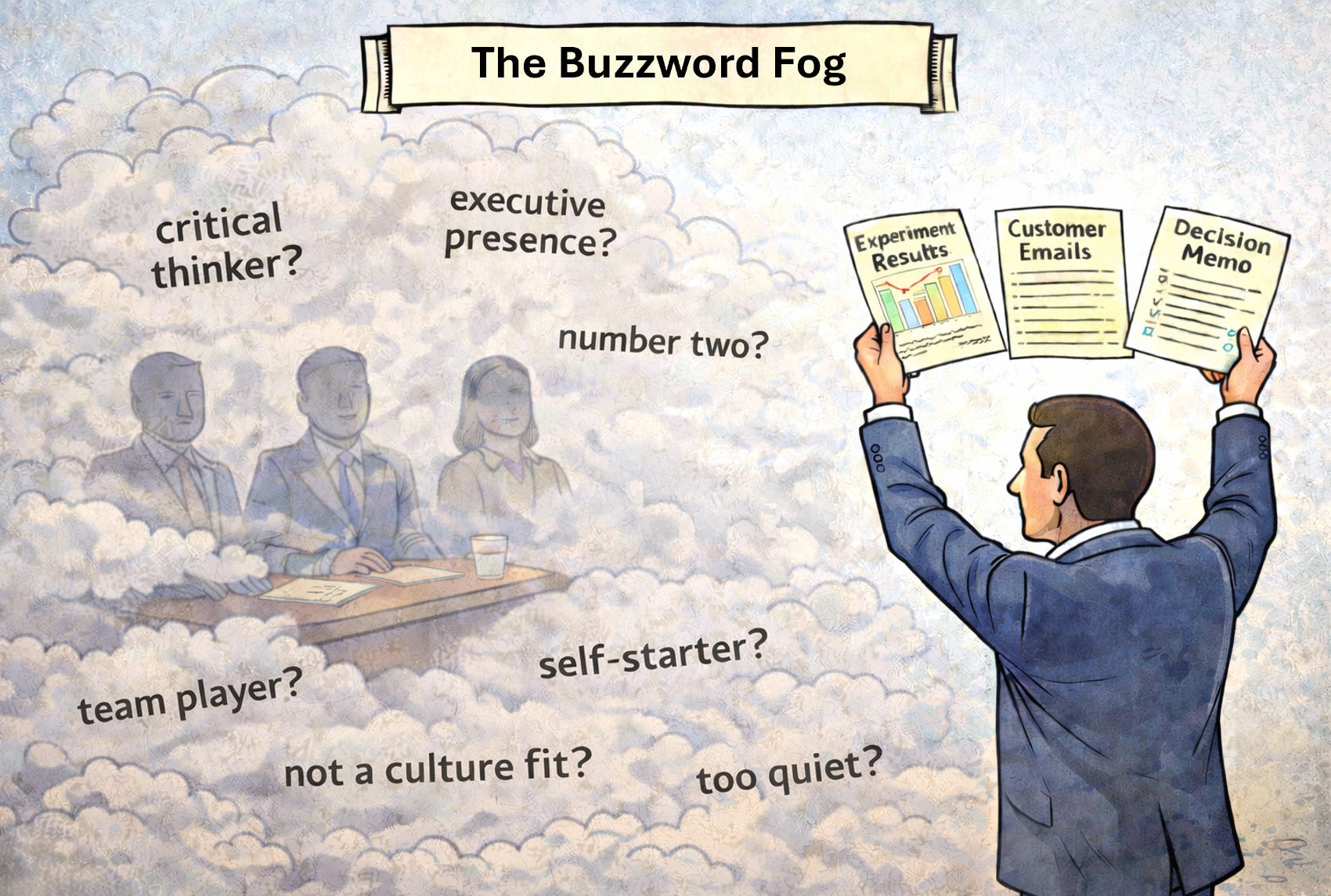
There’s a moment in almost every hiring and promotion meeting when the room stops talking about the work and starts talking about the person.
It usually happens innocently. Someone flips to the résumé’s summary section—those three confident lines written in the voice of a movie trailer—and reads out loud:
“Strategic thinker. Strong leader. Executive presence.”
Everyone nods, because everyone has learned the choreography. Then someone says a sentence that sounds like analysis but works more like a spell:
“She’s not quite a critical thinker.”
And just like that, a human being becomes an adjective.
I once watched a committee do this with a candidate I’ll call Maya. (Composite story, but if you’ve sat in enough rooms like this, you’ve met Maya.) Maya led a messy cross-functional project: three teams, a slipping timeline, a vendor that kept changing specs, and a VP who wanted “innovation” but also “no risk.” The project shipped. Complaints dropped. Finance—the department that hates everyone—sent a thank-you email.
But in the meeting, nobody opened the notes. Nobody replayed the hard conversations. The group argued about a vibe.
“She’s smart, but does she have leadership presence?”
“I don’t know. She’s… quiet.”
A third person, trying to be kind, added: “She might be a great number two.”
At that point, the meeting is essentially over. Here’s what no one said: Maya ran stand-ups like a metronome. She wrote the decision memo that forced the VP to choose. She escalated the vendor issue at exactly the right time. She ended a conflict between engineering and sales by making them define, in writing, what “done” meant.
Those are not adjectives. Those are actions.
And actions are the only honest language of ability.
Our skill vocabulary is mostly nouns—and nouns are sticky
Most of the way we talk about talent is built from nouns and adjectives: critical thinker, strategic, collaborative, high-potential, data-driven, lacks executive presence. Even when we try to be modern and “skills-based,” we mostly just swap prestige signals for skill labels while keeping the same grammar.
That grammar is imprecise, subjective, and—worst of all—infectious. Once someone is labeled “not strategic,” the label sticks, even though ability is contextual and perishable.
Skills are not medals. They’re muscles. They strengthen with use, shrink with neglect, and look different under different loads. You can be “good at public speaking” one year and terrible the next if you stop doing it. You can become a much better writer in six months with feedback and practice.
Résumé culture didn’t invent this. It industrialized it.
A résumé is a compressed autobiography written for a stranger who has no time. It cannot show the work, so it turns a messy sequence of decisions into polished nouns:
“I ran a weekly experiment cadence and scaled the winner” becomes “innovation.”
“I gave tough feedback without losing the person” becomes “leadership.”
“I wrote the memo that forced alignment” becomes “stakeholder management.”
Now take that logic, pour it into LinkedIn, add endorsements, and you get a public vocabulary that feels objective while staying wonderfully vague.
Portability is useful. Portability without precision is where bias shows up, looking “professional.”
And then skills analytics comes along… and freezes the problem in amber
In the last decade, a new class of tools has promised to make skills “data-driven” by mining job postings and résumés at scale. Lightcast, for example, maintains a skills taxonomy built from job postings, resumes, and online profiles.
This is valuable work. It can reveal what employers say they want. It can show skill drift over time. It can help educators align programs to market language.
But notice the subtle trap: if you build your “skills ontology” by extracting phrases from job ads, you inherit the job ad’s grammar—noun phrases, buzzwords, and all the soft, flattering fog that organizations use when they don’t want to specify what they actually mean.
Job ads don’t say: “Can write a decision memo that drives alignment under time pressure.”
They say: “Strong communication skills.”
So the system learns “communication.” The cycle continues.
A different definition: ability is doing a task well, in context
Let’s replace the noun.
A skill is not “critical thinking.”
A skill is doing critical thinking—when it matters, with stakes, constraints, and tradeoffs.
So how do we talk about ability honestly?
Option A: Define it as observable behaviors (verbs)
Take “critical thinker.” What does it look like when it’s real?
It looks like someone who:
Surfaces assumptions.
Tests claims with evidence.
Separates signal from noise.
Makes reasoning visible (in writing, models, or experiments).
You can argue about the list. Great. The moment you move from noun to verb, you’re forced to get specific—and specificity is where fairness begins.
Option B: When behaviors vary, define tasks + outcomes
Sometimes you shouldn’t legislate the exact behaviors, because contexts vary and creativity is required. In that case, define the ability by the task and what “good” looks like.
Instead of “strategic,” say:
Task: Choose a 12–18-month product direction under uncertain demand.
Good looks like: Tradeoffs explicit, stakeholders aligned, milestones measurable, plan revised when evidence changes.
Instead of “strong leader,” say:
Task: Run a team through a high-conflict priority change.
Good looks like: People understand why, roles are clear, delivery stabilizes.
Not perfect. But anchored to reality. It’s about the work, not the aura.
The hard part is granularity
In principle, every meaningful activity inside a job is its own ability:
Can you negotiate scope creep with a vendor without poisoning the relationship?
Can you debug a production incident at 2 a.m. while keeping stakeholders calm?
Can you coach a junior colleague through a mistake in a way that makes them better, not smaller?
Can you write a one-page narrative that a VP will actually read—and then act on?
That kind of specificity is what “ability” really looks like in the wild. It’s also impossible to run as a universal language. Too many edge cases. Too much context. Too much combinatorial explosion.
So we do what organizations always do when something gets messy: we compress. We reach for big nouns: “leadership,” “communication,” “strategic thinking.” They’re portable, which is exactly the problem. The more they travel, the more they mean everything and nothing at once.
What we need is a middle layer: definitions that stay tied to observable behaviors and outcomes, but are expressed at a level that can move across teams, roles, and employers without evaporating.
We can still say “she is a critical thinker,” but only if we can unpack it into observable component behaviors—and then show evidence of those behaviors in action. This is where AI and the “movie of work” ideas I discussed in a previous article become useful: not to replace judgment, but to capture, organize, and surface the behavioral proof that our labels are supposed to represent.
None of that works, though, if the language is sloppy. AI can’t evaluate fog. It needs a vocabulary it can match evidence against—and humans can recognize as fair.
The wiring problem
There’s some good news: the serious work classification systems—O*NET in the U.S., ESCO in Europe, SkillsFuture in Singapore—already lean toward verbs. Many of their skill definitions break down into lists of specific behaviors, not just vague labels.
But they’re missing the connective tissue.
These systems (and, for that matter, most job descriptions) tend to list tasks and skills side by side, like two separate inventories: “Here are the tasks for this job. Here are the skills for this job.” They’re cataloged in parallel, like ingredients on one shelf and finished dishes on another, with no recipe connecting them.
That’s the problem. Skills aren’t a separate thing. They’re what shows up while you’re doing the tasks. You can’t hire for “communication” in the abstract—you need to know: Can this person explain a technical decision to a non-technical executive? Can they do it in writing, in one page? Can they make it clear enough that the executive actually acts on it?
The question a hiring manager actually needs answered isn’t “Does this occupation require communication skills?” It’s more specific: “Which tasks in this role depend on communication? What does good communication look like in this context—when you’re translating technical choices for business stakeholders, with limited time, and real money on the line?”
And now the world is moving from jobs to tasks
This matters more because the labor market is changing its unit of analysis.
More organizations are planning work not as fixed “jobs” but as bundles of tasks and outcomes that can shift among people, teams, contractors, and now AI systems.
You can see the shift in small places first: project marketplaces that staff work in weeks, not years; performance reviews that increasingly cite artifacts (memos, dashboards, recordings) rather than memories; teams that split deliverables between humans and copilots. The unit that matters is no longer “Who are you?” but “What can you do next, and under what conditions?”
Once you see work that way, the missing linkage becomes obvious: if work is modular, your language for ability must be modular too.
You can’t run a task-based world on adjective-based language.
An agenda for getting this right
If we want a labor market that rewards evidence rather than aura, we need a practical language for ability—one that defines what people can do in terms of behaviors and outcomes, not flattering nouns. It has to be simple enough to scale, concrete enough to assess, and flexible enough to travel across roles and industries. Here’s a workable path:
Build libraries of task families—the recurring verbs of modern work (diagnose, persuade, prioritize, write, forecast, negotiate, design, coach, debug).
For each task family, define a handful of observable “tells”—the small behaviors that reliably show competent execution (the kinds of moves good managers notice, but rarely name).
Make context first-class: stakes, ambiguity, audience, constraints. Context isn’t a footnote; it’s the difference between theater and performance.
When “how” legitimately varies, define outcomes plus guardrails—what “good” looks like (quality, speed, reliability) and what “good” must never violate (ethics, safety, customer impact).
Create explicit task→ability wiring for roles and projects: which tasks matter most, where the bottlenecks are, and what competent performance looks like in the environments people actually face.
Treat every definition as a hypothesis. Pilot it, test it against real decisions (hiring, promotion, development), tighten what predicts performance, and retire what doesn’t.
I’d love to see O*NET, ESCO, SkillsFuture, and other skills taxonomy efforts push harder in this direction—less parallel catalogs of “tasks over here, skills over there,” and more of the connective tissue that links tasks to evidence. And if any private actor is positioned to mainstream this, it’s LinkedIn: it already sits on the world’s largest skills vocabulary, but today that vocabulary is still mostly nouns and adjectives. A shift toward verbs, behaviors, and task-linked outcomes would be a genuine upgrade to how talent is understood.
Why this matters
When we define skills as nouns, we end up hiring for the ability to sound like a noun.
When we define skills as verbs, we can hire for the ability to do the work.
That shift creates a cascade: clearer hiring, clearer development, fairer assessment, less political promotion. Candidates know what to practice because the target is visible. Managers know what to look for because the work is legible.
Maya doesn’t need “leadership presence.” Maya needs a world that recognizes the work she already did—and shows her the next behaviors she can learn.
We don’t have a talent crisis.
We have a language crisis.
And the fix is grammatical: stop worshiping nouns. Start measuring verbs.
To my readers: if you’ve seen or use skills frameworks that already come close—ones that connect abilities to observable task-level evidence in a usable way—please leave me a comment. I’d love to hear about them.
This is a great callout, Chris — “a human being becomes an adjective” is exactly what happens in those rooms.
Your Maya example (nobody opening the notes; debating “executive presence” instead of the decision memo / escalation timing / forcing clarity on “done”) is such a clean illustration of how bias sneaks in through vague labels.
Curious: if you were advising a hiring committee to try this tomorrow, what’s one small “verb-first” ritual you’d add to the meeting agenda so the discussion stays anchored to evidence (without turning it into a 2-hour rubric exercise)?
It is so true and to the point.